Death Records in Sedgwick County can be accessed through the Kansas Office of Vital Statistics, where you’ll find a searchable database for death certificates, record numbers, and decedent details such as date, place, and cause of death. Whether you need a certified death certificate, a copy for genealogy, or verification of a medical examiner’s note, the online portal supports name, date, and record‑number queries, helping families and professionals obtain the exact documentation they require.
Death Records searches often raise questions about eligibility, identification, and fees, especially when requesting a Sedgwick Countydeath certificate copy or an amended record. Eligible requesters include immediate family, legal representatives, and authorized agencies; they must present valid ID and pay the standard processing charge. The office’s phone line and walk‑in service provide guidance on completing the application, understanding the turnaround time, and navigating restrictions on confidential or sealed files.
How to Search Death Records
Death Records in Sedgwick County are filed through Kansas’s state death-registration system and can be searched by a decedent’s name, date of death, place of death, or registration number. You can also explore death index through available county records. The search helps families locate a death-registration entry and helps eligible requesters identify the record needed for a certified copy. A search result is a locator, not a certified death certificate. Kansas rules control who may obtain a copy and which details an official certificate contains.
Official Search Portal: https://www.kdhe.ks.gov/1165/Office-of-Vital-Statistics
Steps to Search
- Open the Kansas Office of Vital Statistics page and choose the death-record search option.
- Enter the decedent’s full name, then add the date or place of death when the form provides those fields.
- Search by a registration or certificate number when one appears on paperwork from a funeral home, medical examiner, or prior request.
- Review each result by comparing the name, event date, location, and available registration details.
- Follow the official request instructions for an eligible certified copy, required identification, and the current fee before submitting payment.
Death Record Details and Causes
The Kansas Office of Vital Statistics, part of the Kansas Department of Health and Environment, registers death events and provides the statewide index used to find them. A Sedgwick County entry describes a registered death rather than a cemetery listing, obituary, or burial record. Comparing the available fields reduces the chance of selecting a person with a shared name.
The fields displayed can differ by record age and result type. The table lists common elements and their practical purpose.
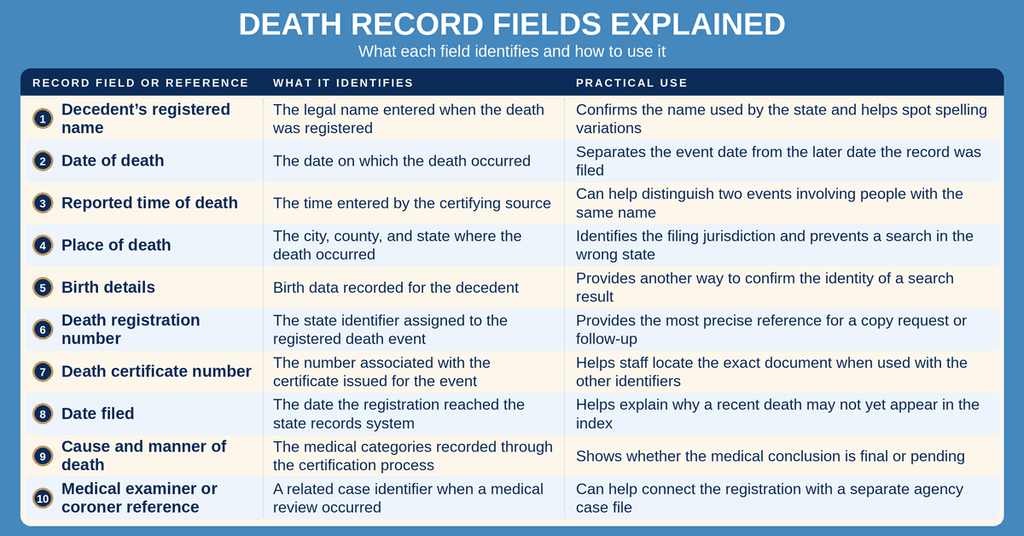
Decedent Identity and Registration Number
A name alone rarely proves that a result belongs to the person you mean. Begin with the full registered name, then compare date of birth, date and place of death, and any registration detail shown. A middle initial, suffix, or spelling variation can create another result for the same person, while two people can share an exact name and event date.
The registration number and certificate number serve different tracking roles. The registration number identifies the event in the state records system. The certificate number appears on the certificate tied to that event. Use the exact number from the document you hold rather than typing one in place of the other. If neither number is known, a careful name-and-date search is the starting point.
An indexed entry can confirm that a death was registered, but it cannot authenticate a document presented by someone else. For formal verification, compare the visible details with a certified copy issued through the state office. A family tree, obituary, or cemetery listing can support a search without serving as proof that a particular paper is an official certificate.
Immediate Family and Eligible Requesters
Finding a record and obtaining a certified copy are separate steps. Eligible requesters include immediate family, legal representatives, and authorized agencies. The requester must show the qualifying relationship or legal authority listed on the current Kansas application and provide acceptable identification.
A search result may be visible to a person who cannot request a recent certified copy. That restriction depends on the death’s age and Kansas public-use rules, not on whether the person found the search page. A third-party researcher, attorney, funeral home, or other authorized agent should follow the applicant category and documentation rules for that role.
Complete every application field, sign as required, and include only the materials needed to verify identity and authority. Do not send original identification or a private document unless the official instructions specifically request it. A request sent without the correct signature, relationship proof, or payment can require another mailing and delay the certificate.
Cause, Manner, and Medical Certification
Cause of death and manner of death are related but separate entries on a medically certified death record. Cause identifies the disease, injury, or sequence of conditions leading to death. Manner classifies how the death occurred, such as natural, accident, suicide, homicide, undetermined, or pending. A cause statement alone does not supply the manner.
A death can contain a chain of causes. Read each line in order rather than treating the first condition as the sole cause. If certification remains pending, the wording shows that the medical conclusion was not final when the record was registered. A later certified copy reflects any officially approved update.
When a medical examiner or coroner handled the case, a case reference may connect the registration to a separate investigative file. That file can contain records not shown in the death index, and access follows the rules of the agency holding it. For a legal, insurance, or benefits purpose, use the certified death certificate rather than an index summary.
Official Certificates and Amendments
The search page and the certified document serve different purposes. The page locates a registered event. A certified copy carries the state’s certification for legal, estate, insurance, benefits, and record-transfer matters. A printout from a database, an obituary, a cemetery record, or a third-party genealogy page is not a certified copy unless the issuing state has certified it.
Certified Copies and Other Record Formats
Several records may refer to the same death, but each has a limited purpose. Read the label carefully before sending a request or accepting a document from another party.
- Search result: Locates an indexed event and may show limited public fields. It does not carry a certification statement.
- Certified death certificate: An official copy issued through the state registration process for use when a certified record is required.
- Certificate verification: Confirms whether a document carries state certification and matches the registered event. A database row cannot provide that proof.
- Corrected or amended certificate: Shows the official version after an approved change. A handwritten correction has no effect on the registered record.
- Third-party record: An obituary, cemetery listing, family tree, or genealogy index can help locate a death but cannot replace a certified certificate.
Required Identification and Processing Fees
The current Kansas request form sets the accepted identification, applicant signature, relationship or authority proof, and fee. Valid identification is required for a copy request. The form controls any additional identity, signature, relationship, or authority documents. If the requester cannot meet those rules, staff can explain the proper certification path before the request is mailed.
A standard processing charge applies to certified-copy requests. Check the amount and accepted payment method on the current official request form or with the office before submission. A fee shown on an older form or third-party site may be wrong. Mail requests should include the exact required payment and all supporting material needed to complete the review.
Processing time depends on the request method, identity review, payment, mail delivery, and whether medical or legal review is needed. A search result does not promise a delivery date for a paper request. Anyone facing a fixed deadline should ask the office about current processing before ordering.
Correcting Errors and Submitting Amendments
A correction and an amendment are not the same. A correction fixes a clerical error, such as spelling, punctuation, or a typographical mistake, without changing the certified facts. An amendment changes a substantive fact, such as the certified cause or manner of death, name, or identity details. That change may require action by the medical certifier, medical examiner, court, or another source with authority over the fact.
The supporting packet depends on the error. A request may need the current amendment form, the applicant’s identification and authority, the existing certified copy, and proof from the person or agency that supplied the disputed fact. Individuals can also check obituary index to verify relevant details. A change to cause or manner can require the original certifier’s statement or medical examiner documentation. A legal order may apply when the requested change cannot be supported by the medical or administrative source.
Submit the correction request through the current KDHE amendment process. A handwritten correction, an updated obituary, or a new database spelling does not change the registered certificate. Once an amendment is approved, request a newly certified copy for any file that must show the change.
Public Availability and Confidentiality
Public use of a death record has two levels: the state index and the certified document. Kansas makes death records open to the public once they reach 25 years of age, while a more recent record remains subject to eligible-requester limits. This age rule runs from the date of death, not the date of the search or the date the family first requested a copy.
Other records can help with a search, yet none replaces the state-certified death certificate unless the document itself is certified.
Confidential Medical and Sealed Details
A public death index can be more limited than the full registered record. Recent records can restrict who receives a certified copy, and some medical details or related case materials may remain outside the index. A search result that shows a decedent’s name and event date does not grant access to every field, attachment, or supporting document.
Sealing or withholding follows the applicable Kansas law and the type of record. If a result marks a detail as unavailable, the search page cannot remove that restriction. The requester must use the eligibility route stated by KDHE. A third-party image does not bypass that rule.
Medical examiner and coroner files should be treated as separate agency records. A case number found during a death-record search can help the proper office match the file, but the cause shown on an index or certificate remains the certified cause recorded through the state registration process.
Historical Death Records After 25 Years
For a death that occurred at least 25 years ago, begin with the state death index and search the decedent’s name with the year of death. Add county or place when the result set is broad. Confirm that the result names the correct place of death before requesting a document. A family may have lived in Sedgwick County even when the death occurred in another county or state.
Older records can carry spelling variations, abbreviated names, or jurisdiction changes. Compare the event date, place, and registration details across possible matches. A surname change or residence-based family tree can point to the same person without proving that two search results are duplicates.
Open historical use does not remove the need for a certified document when a court, insurer, estate, or other agency requests proof. The index helps narrow the record; the issuing office produces the certified copy. For an old entry that cannot be matched confidently, submit the event details and any known registration number to KDHE rather than treating a genealogy entry as a match.
Record Accuracy and Resolution
A failed search does not always mean the death was never registered. Names can differ across records, filing can be delayed, and the death may belong to another filing jurisdiction. A careful resolution process separates those issues from a genuine record that has not reached the public index.
Similar Names and Conflicting Matches
When several results share a name, compare every displayed field rather than choosing by order. Date of birth, date and place of death, sex, registration number, and next of kin can distinguish people with the same name. If the result shows only a name and year, avoid a firm identity decision until stronger details align.
Use a broader search after an exact-name query returns nothing. Remove a middle name or suffix, try the surname with and without a hyphen, and search by event date or place. Keep a record of the exact terms used. That record makes it easier to distinguish an empty result from a mistaken spelling or an incomplete file.
If two entries point to one event, compare their registration numbers before treating them as separate deaths. Matching registration numbers and repeated identifiers provide stronger evidence than a shared name. If the numbers differ, examine the dates, places, and other displayed fields before drawing a conclusion.
Multi-Jurisdiction Filing Delays
The place where the death occurred usually controls the filing jurisdiction, meaning the office that registers the event. A Sedgwick County death belongs in Kansas’s death-registration system even when the decedent lived elsewhere. A death recorded in another Kansas county may require a request through that county’s registration route, and an out-of-state death belongs with the state or local jurisdiction where it occurred.
Registration can lag behind the event while a certificate is pending medical certification, a medical examiner or coroner completes review, or an administrative correction is made. The date of death remains the event date; the filing date is a separate fact. A result that becomes visible after filing can still show a pending cause if the medical conclusion had not been completed at that point.
If a death occurred outside Kansas, do not expect the Sedgwick County or statewide Kansas index to contain that event. Use the death’s actual location to identify the responsible jurisdiction. For a Kansas death that remains unlisted, check current KDHE filing guidance before treating the record as missing.
Unlisted Death Record Resolution
Use this sequence when the search returns no result or an incomplete record:
- Confirm the decedent’s legal name at the time of death, including any prefix, suffix, or spelling used on source documents.
- Check the date and place of death, then decide which jurisdiction registered the event.
- Search once more with a broad surname and event year, then inspect close matches for a registration number or alternate spelling.
- Gather any death certificate number, medical examiner or coroner reference, funeral-home record, and date filed that appears on paper records.
- Submit the available identifiers to KDHE for record matching, and state clearly whether the request concerns a missing index entry, a delayed filing, or an error in a found record.
A missing online entry can reflect an indexing delay, a record held by another agency, or a search that used the wrong jurisdiction. It can also reflect a recent event whose certified copy is restricted. The right resolution depends on which of those facts applies.
When the record is found but contains a wrong name, date, place, cause, or manner, use the correction process rather than repeated searches. A certified-copy request answers whether a document exists. The amendment process answers whether its contents are correct.
Contact Information
Contact the office for help matching a Sedgwick County entry, confirming a request category, checking the current fee, or resolving an amendment. The office serves telephone and walk-in requests for statewide vital records.
Frequently Asked Questions
Find quick answers about locating, requesting, and correcting death records in Sedgwick County, Kansas.
How to search Sedgwick County death records online?
Use the Kansas Department of Health and Environment portal at https://www.kdhe.ks.gov/1165/Office-of-Vital-Statistics. Select the death‑record search option, then enter the decedent’s name, date of death, place of death, or registration number. The system returns a locator entry that shows the record’s existence but not the full certificate. This lookup helps you confirm the correct record before requesting an official copy from the Kansas Office of Vital Statistics.
What info is needed for a death certificate request?
You must provide the decedent’s full legal name, date of death, and place of death. Include the death‑record number if known. A government‑issued photo ID is required to verify your identity. If you are not a direct relative, you may need proof of a legal interest, such as a court order. Submit the request by mail, fax, or in person to the Kansas Office of Vital Statistics, using the contact number (785) 296‑1400 for assistance.
Who can obtain a certified death certificate in KS?
Authorized requesters include the surviving spouse, children, parents, grandparents, and legal representatives of the decedent. Government agencies, funeral homes, and attorneys involved in estate matters may also request a copy. Unrelated individuals must demonstrate a documented need, such as a court proceeding, to receive a certified certificate. The Kansas Office of Vital Statistics verifies eligibility before releasing the document.
How long does a death certificate request take?
Processing time varies by request method. In‑person submissions at the Topeka office are often completed the same day. Mail or fax requests typically require 5‑7 business days after the office receives all required documents and payment. Delays can occur if additional verification is needed, so plan ahead for legal or burial arrangements that depend on the certificate.
Can I correct errors on a Sedgwick County death record?
Yes. If you find inaccurate information, submit a correction request to the Kansas Office of Vital Statistics. Include the original death‑record number, a copy of the certified certificate, and supporting documents that prove the correct details, such as a birth certificate or court order. The office reviews the evidence and issues an amended death certificate when the correction is approved.